Front-Mounted vs Rear-Mounted Overhead Launch Monitors: Which Setup Fits Your Bay?
May 14, 2026
Overhead launch monitors come in two configurations: front-mounted and rear-mounted. Both are ceiling-mounted, both keep the unit out of the ball's flight path, and both eliminate the floor footprint that older launch monitors required. But the practical experience of living with each is different. This guide walks through the differences so you can pick the right mount style for your bay.
The Short Answer
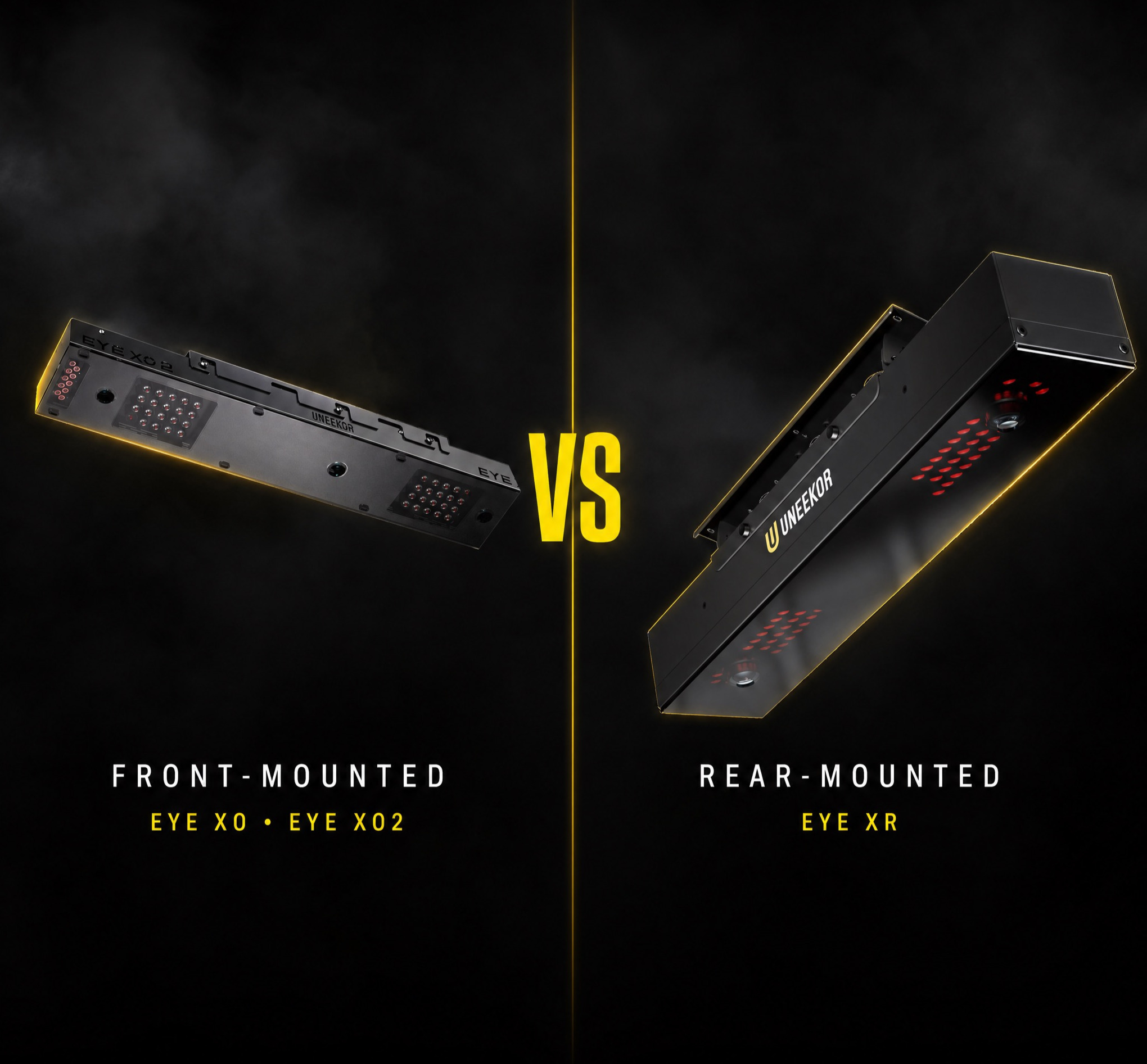
- Front-mounted overhead launch monitors sit above the front of the hitting area, looking back toward the player. The EYE XO and EYE XO2 are front-mounted.
- Rear-mounted overhead launch monitors sit behind the player, looking forward. The EYE XR is rear-mounted.
- Both keep the floor clear, both eliminate ball-strike risk, both support left-handed and right-handed swings without repositioning.
Front-Mounted: What It Means in Practice
A front-mounted overhead launch monitor lives on the ceiling between the hitter and the screen. It looks back toward the player and reads the ball and club from that angle.
Strengths: broadest possible measurement view because the unit faces the swing directly. Larger hitting zones are easier to engineer from this position. The EYE XO2 delivers the largest hitting zone in the lineup (28" x 21") from a front mount, making it the most forgiving unit for walk-in customers or varying ball placements.
Trade-off: the unit is in the player's forward field of view. For commercial bays and serious training environments this is a non-issue. For finished home bays with a focus on aesthetics, some buyers prefer the rear-mount alternative.
Rear-Mounted: What It Means in Practice
A rear-mounted overhead launch monitor lives on the ceiling behind the player, looking forward toward the screen. It reads the ball and club from over the player's shoulder.
Strengths: the front of the bay stays completely open. Sightlines from the hitting position to the screen are unobstructed. The EYE XR is the only rear-mounted unit in the Uneekor lineup and the most compact overhead unit on the market at 22.4" long. Power over Ethernet keeps installation to a single cable.
Trade-off: the hitting zone is smaller than the front-mounted XO2 because the measurement geometry from behind the player is more constrained. The EYE XR's hitting zone is 13.7" x 11.8", which is more than enough for normal swing variation but less forgiving than the XO2 for varied ball placement.
Installation Differences
Both mount styles install on the ceiling. The cable run, structural attachment, and clearance considerations differ slightly.
- Front-mounted units typically need the ceiling area between the hitter and the screen to be clear of obstructions like beams or HVAC ducts.
- Rear-mounted units need the area behind the hitter to be clear, which is often easier in finished bays where the back of the room is less crowded.
- Power over Ethernet (used by the EYE XR) means a single cable handles both data and power, which keeps the install clean regardless of mount style.
- All three Uneekor overhead units mount close to the ceiling, leaving headroom for the swing.
For a step-by-step installation walkthrough, see our overhead golf simulator setup guide.
Ball-Strike Risk: Why Overhead Wins Either Way
Both front and rear-mounted overhead units sit completely out of the ball's flight path. This is the structural advantage overhead has over floor-standing launch monitors. In a commercial bay running hundreds of shots a day, zero ball-strike damage to the launch monitor translates directly to lower maintenance costs and longer hardware life. In a home bay, it removes one of the most stressful unknowns of indoor practice.
Choosing Between Front and Rear Mount
Pick rear-mounted (EYE XR) if:
- You are building a finished home bay where aesthetics matter.
- You want the smallest, most compact overhead unit available.
- You want a single-cable install (PoE) and minimal complexity.
- You want the most accessible AI Studio price point ($5,999).
Pick front-mounted (EYE XO or EYE XO2) if:
- You want the deeper 24-point data set.
- You want the larger hitting zone (especially the XO2's 28" x 21").
- You are running a commercial bay where walk-in customer forgiveness matters.
- You are a coach or fitter who needs the most detailed club and ball analytics.
Final Word
Front-mounted and rear-mounted overhead launch monitors are not better or worse versions of each other. They solve slightly different problems. The EYE XR wins on compactness and finished-bay aesthetics. The EYE XO and EYE XO2 win on data depth and hitting zone size. All three ship inside an AI Studio bundle with Swing Optix cameras, tripods, AI Trainer, and the full Uneekor software ecosystem.
Compare all three units side by side | Shop the AI Studio bundle
Legal