
Photometric vs. Radar: Which Launch Monitor Technology Delivers the Most Accurate Golf Data?
Nov 24, 2025
When golfers start researching a home golf simulator or comparing options in a serious launch monitor comparison, one question consistently rises to the top: photometric vs doppler radar. Which technology actually delivers the most accurate golf data?
The honest answer is that both technologies have achieved real success. Doppler radar systems have long been trusted outdoors, particularly on driving ranges and professional practice facilities where full ball flight can be tracked over long distances. Photometric systems, on the other hand, have transformed the indoor golf simulator market by capturing incredibly detailed data in confined environments, while still being just as practical outdoors.
Uneekor have chosen to focus exclusively on photometric technology because it delivers the kind of accuracy, consistency, and insight that indoor golfers demand. Whether it is the portability of the EYE MINI or the ceiling-mounted precision of the EYE XO2, our systems use high-speed camera technology and infrared tracking to provide up to 24 club and ball data points accurately, and reliably.
What Is a Photometric Launch Monitor?
A photometric golf launch monitor uses high-speed cameras to capture a sequence of images during and immediately after impact. Instead of tracking the ball across long distances, it analyzes the data at impact with extreme precision. The system then calculates launch angle, spin rate, spin axis, ball speed, and, in many cases, detailed club data.
Uneekor enhances this approach with proprietary technologies such as Dimple Optix and Club Optix. Dimple Optix captures the dimples of any white golf ball at high frame rates to calculate true spin characteristics. Club Optix provides visual strike feedback so golfers can actually see what happened at impact rather than relying solely on numbers.
Because the system operates in a controlled indoor environment using infrared lighting, the cameras are not dependent on sunlight or long ball flight. This is particularly valuable in garage golf simulators and basement golf simulator setups where space is limited.
The primary advantage of photometric technology is direct measurement. Spin is not inferred from ball flight over distance. It is calculated from actual rotation captured in high-speed imagery. This level of detail is especially important for golfers working on shot shaping, dialing in wedges, or analyzing dispersion patterns in a practice range simulator environment. This is especially important when looking to improve your game. The accuracy of camera based technology, combined with VIEW and our AI Trainer, you know you can trust the results you're seeing.
Photometric systems also integrate seamlessly into overhead installations. Models like the EYE XO and EYE XO2 are mounted above the hitting area, eliminating the need for devices behind the golfer and creating a clean, tour-like hitting bay.
Photometric systems do have considerations. They perform best indoors, and some models outside of Uneekor launch monitors may require club stickers for full club data capture. However, Uneekor continues to innovate in this space with AI-driven tracking advancements and rear-mounted options such as the EYE XR. In practical terms, for indoor golf simulation, these limitations are minimal compared to the performance benefits.

What Is a Doppler Radar Launch Monitor?
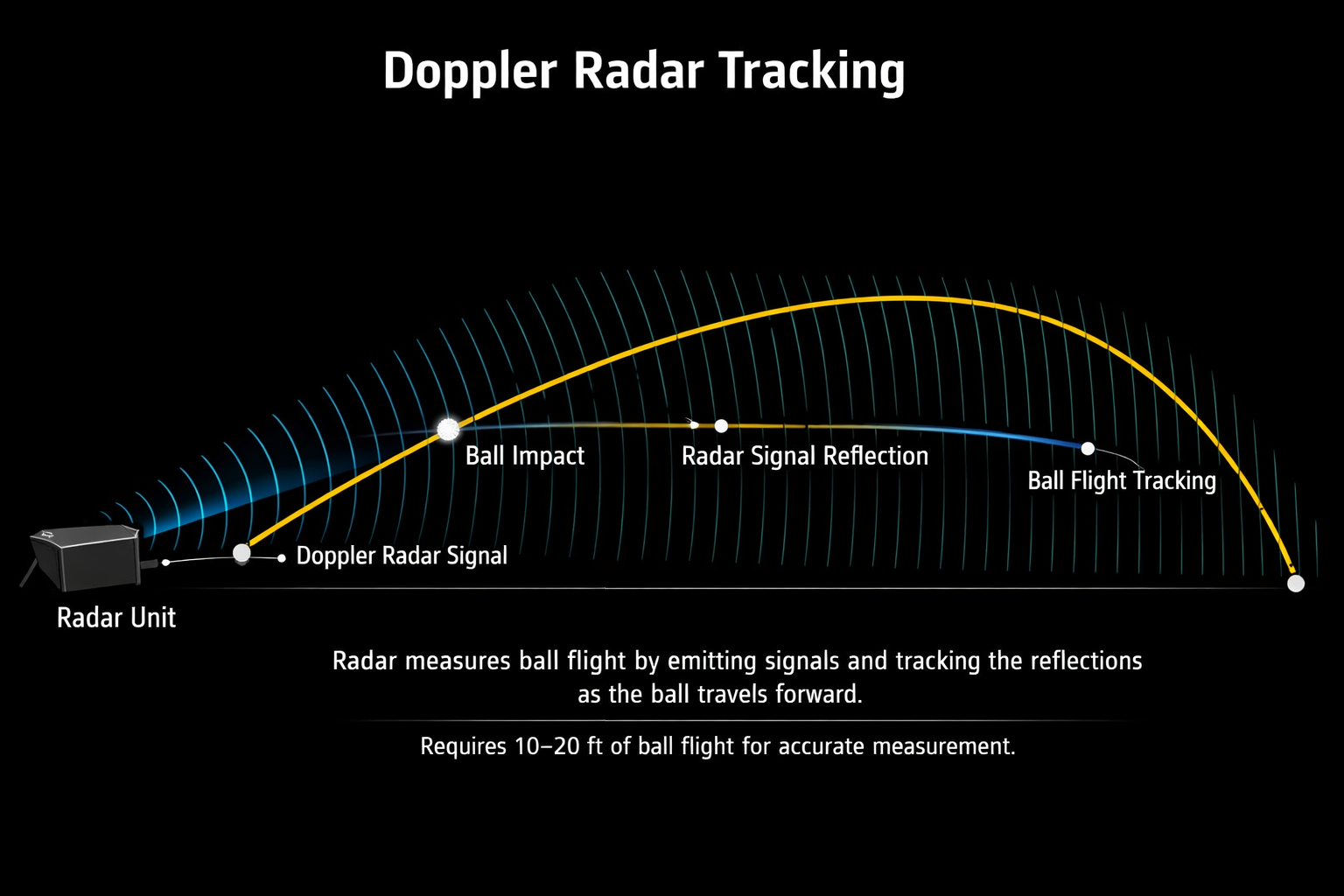
A doppler radar launch monitor works very differently. It emits microwave signals that reflect off the moving golf ball. By measuring frequency shifts in the returning signal, the radar calculates ball speed, trajectory, and other flight characteristics.
Radar technology is effective outdoors because it can track the ball over long distances. On a driving range with significant ball flight, radar can gather extensive data from actual flight rather than modeling it.
The strengths of radar technology are clear in large, open environments. It typically does not require impact stickers. It can track full carry distance outdoors. It is highly portable and convenient for players who split time between range sessions and on-course practice.
However, the limitations become more noticeable indoors. Radar systems rely on space to track the ball. In a garage or basement where ball flight may be limited, the radar must rely more heavily on algorithms and modeling to calculate spin and curvature. This can lead to inconsistencies, particularly with spin axis and side spin.
Radar systems can also be sensitive to environmental factors. Metal objects, walls, and tight spaces can affect signal performance. Precise alignment directly behind the golfer is critical, and small setup errors can impact readings.
Radar isn't inaccurate, it simply performs best in the environment it was designed for: open, outdoor spaces with extended ball flight. When evaluating radar vs camera launch monitors specifically for indoor use, the differences become more pronounced.
Why Uneekor Chooses Photometric Technology
Uneekor’s mission is to enhance lives through authentic golf experiences and to transform indoor golf for the modern Balanced Competitor. That mission naturally aligns with photometric technology. With indoor golf simulation growing rapidly in the United States, more golfers are building DIY golf simulator setups, investing in golf simulator packages, and looking for the best launch monitor for home use. These environments typically offer limited depth but controlled lighting and stable installation conditions. Photometric technology thrives in exactly this setting.
By pairing high-speed cameras with infrared illumination, Uneekor systems capture real spin and launch data immediately at impact. Dimple Optix supports accurate ball tracking, while multi-camera systems in products like the EYE XO2 deliver robust club-and-ball data and a larger hitting zone. The result is consistency shot after shot, which is critical for both serious practice and immersive simulation play.
For B2B partners such as teaching professionals and indoor golf facilities, this consistency builds trust with students and customers. For resellers and installer partners, overhead photometric systems provide clean integration into enclosures and commercial builds. For residentials, it means confidence that their data is reliable in a garage or basement environment.

Why is Photometric the Best Solution for Me?
If your primary goal is to build a golf simulator for home, photometric technology is almost definitely the better fit. Most residential simulator rooms do not have the uninterrupted ball flight that radar systems prefer. Photometric systems are engineered specifically for this scenario.
Photometric is particularly well suited if you value detailed clubface data, direct spin measurement, overhead mounting options, and consistent performance in small spaces. It is also ideal if you want a clean hitting area without devices positioned behind you.
Radar may make more sense for golfers who primarily practice outdoors on full-length driving ranges and only occasionally bring the unit indoors. In that environment, its ability to track long ball flight becomes a clear advantage. But for the golfer building a dedicated indoor golf simulator, photometric technology provides accuracy without compromise. It eliminates the need for excessive space, reduces environmental interference, and delivers the type of high-resolution impact analysis that supports real improvement.
Camera-based Launch Monitors are the way to go
Both photometric and doppler radar launch monitors have earned their place in the game. Each technology has strengths that align with different environments and player needs.
However, when accuracy is evaluated specifically within the context of indoor golf simulation, small-space setups, and home golf bays, photometric technology consistently delivers more reliable spin measurement, better clubface insight, and stronger overall performance.
That is why Uneekor has committed to advancing camera-based launch monitor systems across our lineup. By combining high-speed cameras, infrared precision, and software such as VIEW and REFINE, we empower golfers to practice with confidence and play with purpose.
For golf simulation, photometric technology is not just a competitive choice. It is the game changer.
Legal